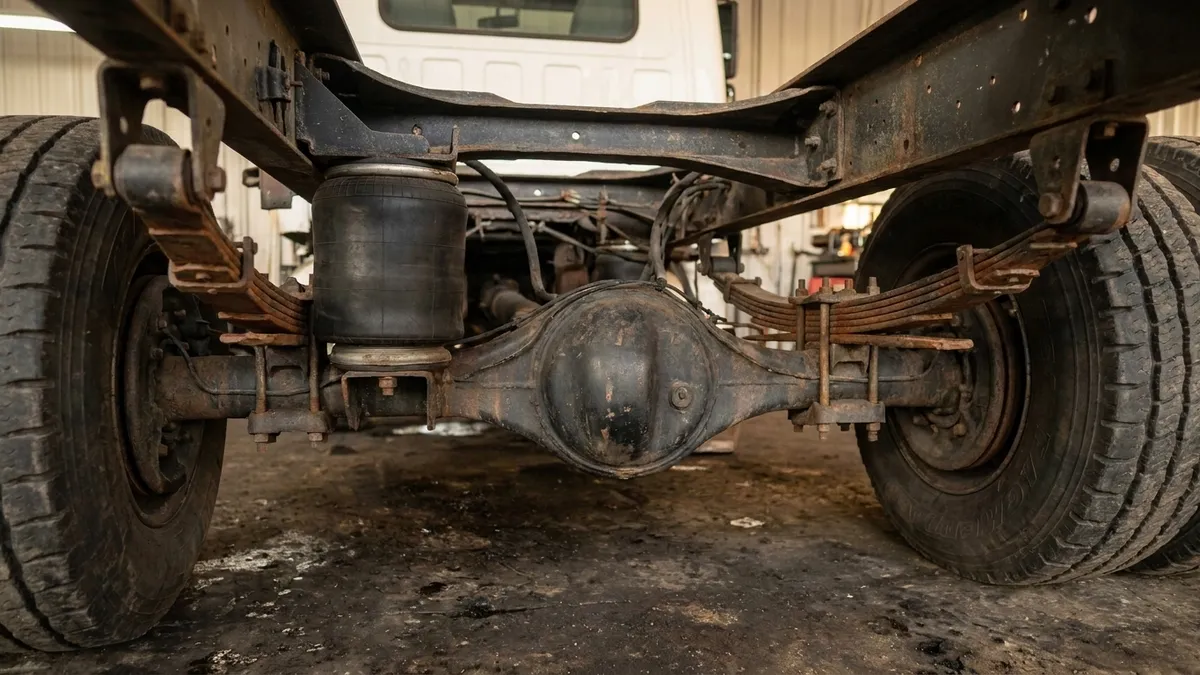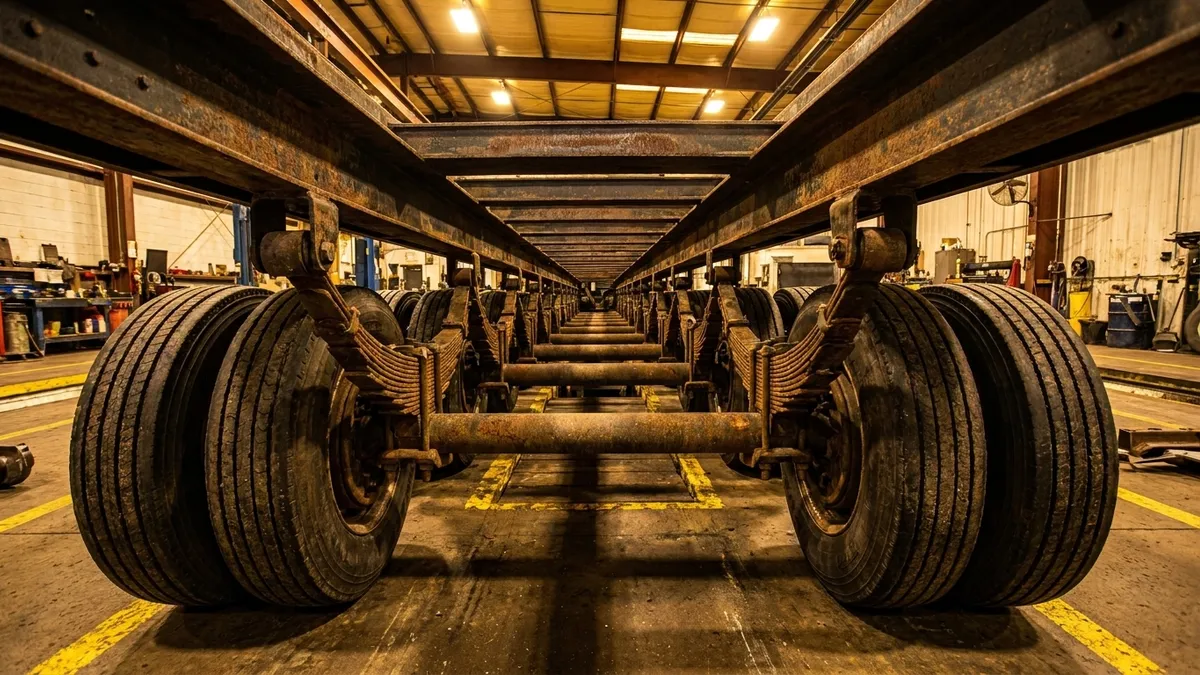

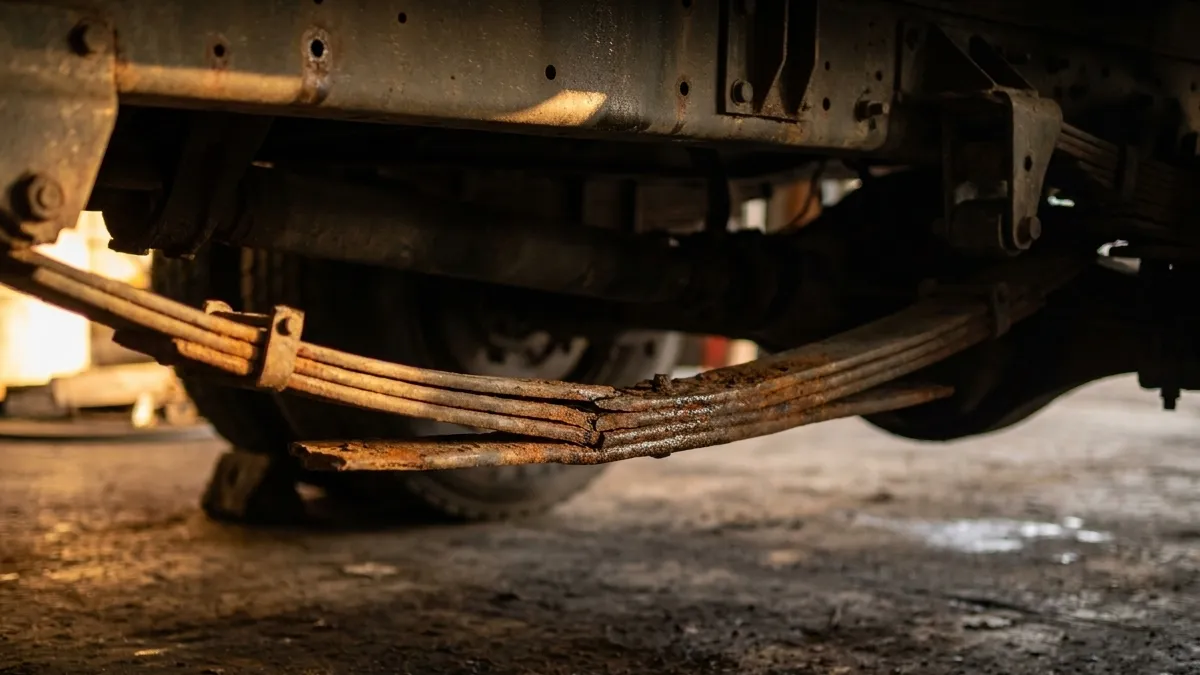
A leaf spring almost never snaps out of nowhere. It gives warning for weeks, sometimes months. The trouble is that the warnings are easy to live with — the truck still drives, so the job gets pushed to next week until a leaf breaks on a loaded run and the vehicle is off the road for days instead of hours.
These are the five signs we see most often in the workshop, in the order drivers usually notice them.
1. The vehicle sits lower on one side
Park the truck on flat ground, stand well behind it and look at the gap between the tyre and the body on both sides. If one side sits noticeably lower, that spring pack has lost its arch.
A leaf spring works by being curved. As leaves crack or the pack fatigues, that curve flattens out and the vehicle drops. Once it is flat, the axle starts hitting the bump stops over every bump — which is exactly the load the chassis was never designed to take.
2. The ride has gone hard and noisy
Drivers describe this as the truck feeling “solid” or “dead” over bumps, especially when empty. That is a spring pack that has stopped flexing properly, either because leaves are broken or because the pack has seized with rust between the leaves.
Listen for a metallic clunk or a squeak from under the vehicle when you go over a speed bump slowly. A squeak often means dry, rusted leaves rubbing. A clunk usually means play in the shackles, pins or U-bolts.
3. Visible cracks, or a leaf out of line
This is the one you can check yourself in two minutes. Get down beside the wheel with a torch and look along the length of the spring pack.
- A leaf that ends in a different place from the ones around it has broken
- A hairline crack near the centre bolt is the most common failure point
- Heavy flaking rust between the leaves means the pack has been working dry for a long time
- If the leaves have spread apart sideways, the centre bolt has sheared
A single broken leaf is not an emergency the moment you find it, but it is a job for this week, not next month. The remaining leaves are now carrying that share of the load too, so the next one goes faster.
4. Tyres wearing unevenly
A sagging spring changes the angle the axle sits at, which changes the angle the tyre meets the road. The result is wear concentrated on one shoulder of the tread rather than spread evenly across it.
This is why replacing a tyre without checking the suspension is throwing money away — the new tyre will wear the same way. If you want to work out which fault your wear pattern points to, our tyre wear pattern checker walks through the six common patterns.
5. The truck pulls, or the steering sits off centre
When one spring pack has sagged more than the other, the axle is no longer square to the chassis. The vehicle tracks slightly sideways and the driver corrects for it without really noticing — until the steering wheel is visibly off centre on a straight road.
On a trailer there is no steering wheel to warn you, which is why trailer springs get ignored the longest and trailer tyres get destroyed the fastest.
What it costs to wait
A worn spring pack is a repair. A snapped leaf on a loaded highway run is a recovery, a lost day, an angry customer, and often a bent chassis rail or a destroyed tyre on top of the spring bill.
The check itself takes minutes. Drive in and we will look underneath and tell you honestly whether it needs doing now or whether it will hold until the next service.
What we do about it
Depending on what we find, that is:
- Replacing individual leaves where the rest of the pack is sound
- Re-arching a pack that has flattened but is not cracked
- Fitting a complete new pack, usually from stock so the vehicle is not waiting
- Renewing U-bolts, centre bolts, pins and bushings — these go with the job, not after it
- Upgrading to a heavier duty pack if the vehicle is consistently carrying more than the original spring was specified for
More detail on our leaf spring repair service.